


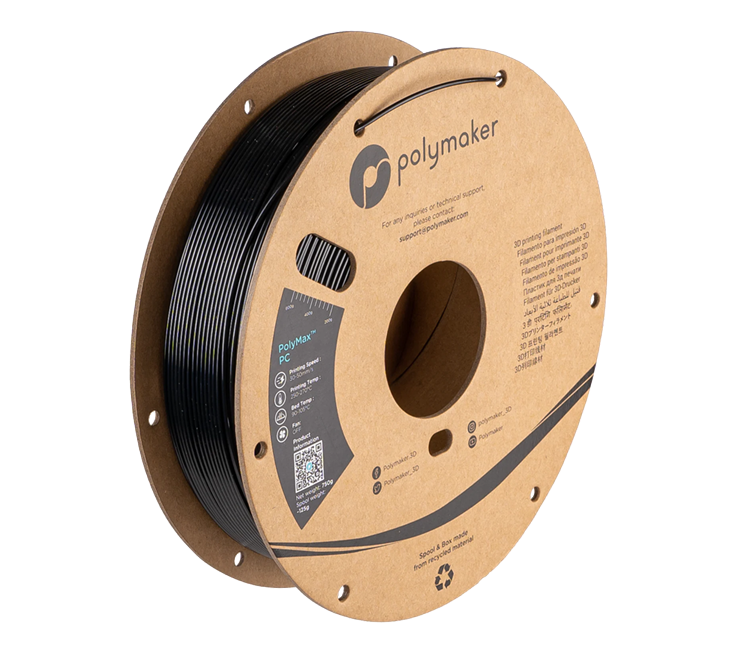
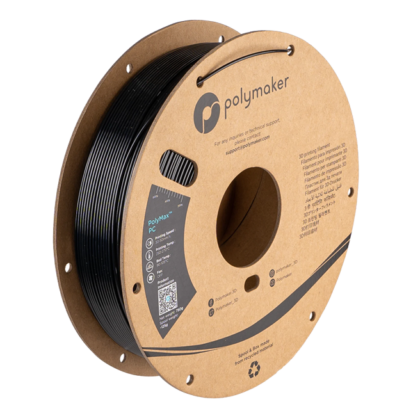
PolyMax PC Black 750g Polymaker
The best-selling polycarbonate (PC) filament for desktop 3D printers
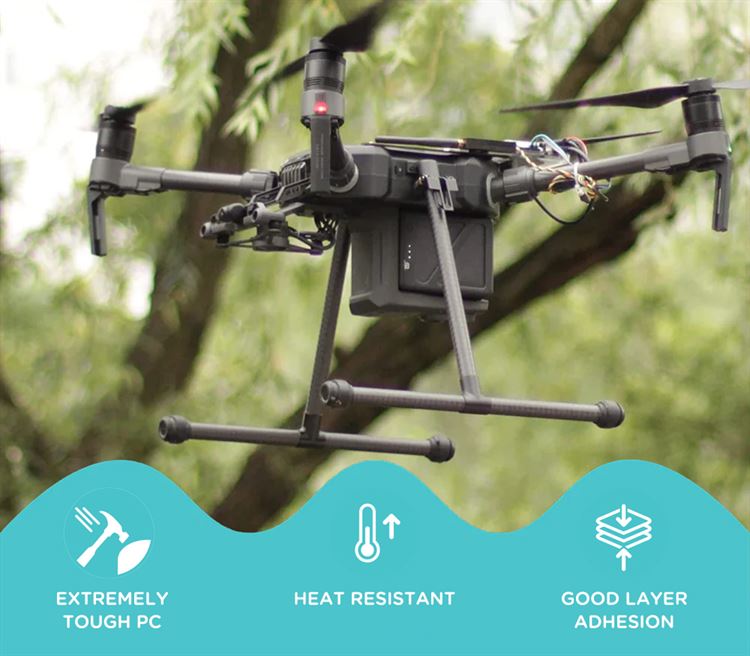
PolyMax™ PC is an engineered polycarbonate filament that combines exceptional strength, impact resistance, heat resistance and excellent print quality. It outperforms many other PC materials while printing at a relatively lower temperature.
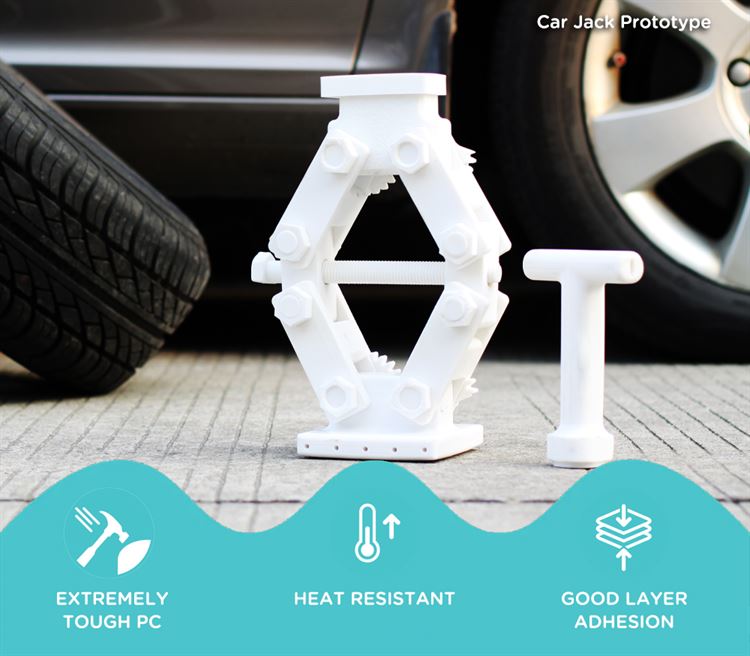
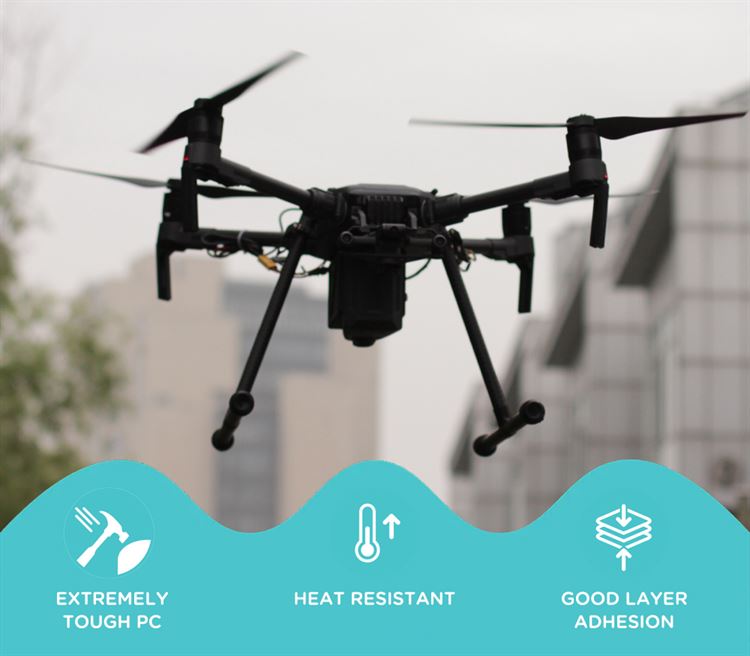
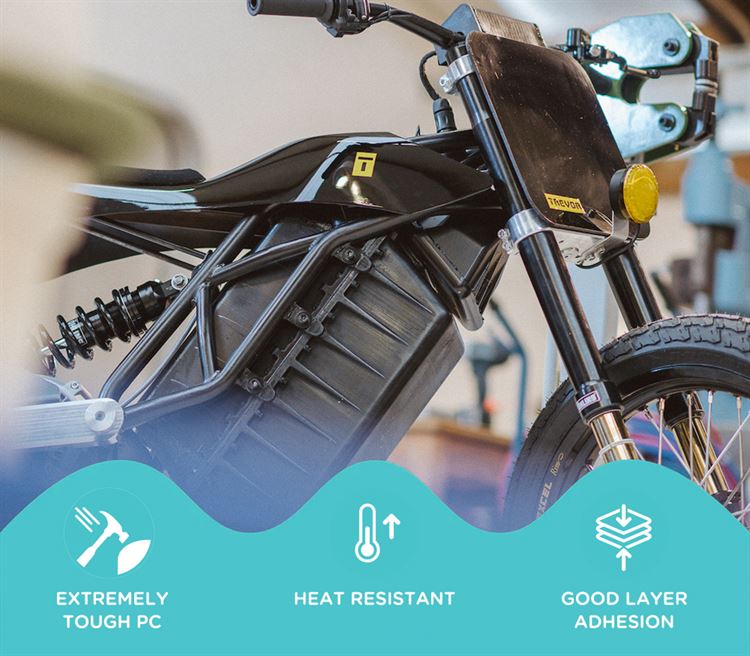
With heat resistance (HDT) to 114°C (0.45 MPa), PolyMax™ PC is suitable for applications in busy environments where there are shock loads, high temperatures and vibration.
Main features
- Best in class strength – PolyMax™ PC is designed to provide exceptional mechanical strength and durability. Thanks to Polymaker’s Nano-reinforcement technology, the material outperforms ABS, ASA, PETG and PLA in a range of mechanical tests.
- High heat resistance – The material offers excellent heat resistance, with HDT up to 114°C (0.45 MPa), making it suitable for functional and industrial applications.
- Improved printability – PolyMax™ PC was developed with a focus on ease of use and compatibility. With an extrusion operating temperature of 250 – 270°C, it can be used on a wider range of desktop 3D printers. It requires a heating table above 90°C and the use of a closed chamber is recommended.
- Guaranteed Quality – Thanks to Polymaker’s rigorous quality control and in-house testing, every spool delivers reliable printing and consistent results.
Print settings
Nozzle temperature: 250°C -270°C
Heating table temperature: 90°C – 105°C
Print Surface: works well with most surfaces (glass, BuildTak®, etc.). Rigid backing is recommended instead of magnetic flexible plates.
Surface treatment: recommended Magigoo PC
Closed chamber: recommended
Heated chamber: recommended on some models. Up to 70°C for greater detail and higher density.
Cooling fan: off for better robustness. Low speed as needed.
Print speed: 30 – 50 mm/s
Retract settings:
– Direct Drive: 1 mm at 20 mm/s
– Bowden: 3 mm at 40 mm/s
Self-supporting material
For larger or dense patterns, pre-heating the platform for 20-30 minutes before printing is recommended.
In colder climates, a longer warm-up may be necessary.
Annealing of polycarbonate
For maximum mechanical properties, annealing of parts printed with PolyMax™ PC is recommended.
Annealing is the process of heating a finished part to a specific temperature for a specific period of time.
The purpose is to release the internal tension accumulated during the printing.
If the part is not annealed soon after printing, these internal stresses can lead to micro cracks and weakening of the structure.
Recommended annealing settings: 90°C for 2 hours
Specifications
Net Weight: 750 g
Material Type: Tough PC
Density: 1.19 g/cm³ at 21.5°C
Compatibility
PolyMax™ PC has been developed with compatibility in mind and offers excellent printing results with a wide range of professional 3D printers.
The material requires a heating table and the use of a closed chamber or heated chamber is recommended for larger or thinner models.
Due to the variety of 3D printers on the market, full compatibility with every model cannot be guaranteed.
For best results it is necessary to adjust the parameters in the slicer.
Before starting a more complex project, it is recommended to print test models for calibration.
Technical data
All test specimens were printed under the following conditions: nozzle temperature 270°C, heating table temperature 105°C, chamber temperature 90°C, infill 100%, cooling fan off.
All specimens were conditioned at room temperature for 24 hours prior to testing.
Fire resistance
Combustibility Class: V2 (UL94)
For applications requiring higher fire resistance (UL94-V0), PolyMax™ PC-FR is recommended.
Thermal properties
Glass Transition Temperature: 113°C
Heat Deflection Temperature (HDT):
– 0.45 MPa: 99.3°C
– 1.8 MPa: 114.1°C
Vicat Softening Temperature: 116.9°C
Mechanical properties
Young’s Modulus (X-Y): 2,435 MPa
Tensile Strength (X-Y): 53.44 MPa
Tensile Strength (Z): 41.43 MPa
Elongation at Break (X-Y): 4.53%
Flexural Modulus (X-Y): 2,050 MPa
Flexural Strength (X-Y): 81.29 MPa
Impact Strength (Charpy X-Y): 21.28 kJ/m²
These values are indicative and are intended for comparison.
Due to the specifics of 3D printing, they should not be used directly for engineering design or quality control.
Storage and drying
All plastics are hygroscopic, which means they absorb moisture from the air. This can affect print quality and the strength of printed parts.
The rate of absorption depends on the material and the environment. PolyMax™ PC films are factory dried and vacuum packed with a moisture-absorbent package to ensure optimum print quality.
When not in use, should be stored in the original sealable packaging.
Although filaments can be re-dried, this process accelerates the aging of the material. The best approach is to prevent moisture absorption.
For long-term storage, the use of an airtight container with a desiccant that maintains humidity below 20% RH is recommended.
In production conditions, the filaments are stored with the Polymaker PolyDryer™ system, which provides excellent sealing and moisture protection.
If there is a popping sound when printing or a change in the consistency/color of the filament, this is a clear sign of moisture absorption.
In this case, the filament must be dried.
PolyMax™ PC can be dried with a Polymaker PolyDryer™ (low power) or in a convection oven at approximately 75°C for up to 12 hours.
Results may vary depending on the accuracy of the unit, so careful temperature control is recommended.
For more information on drying filaments, see the manufacturer’s official manual.
Frequently Asked Questions (FAQ)
Q: Polymaker offers different PC filaments – which one should I choose?
A: PolyLite™ PC and PolyMax™ PC are the best choice for standard applications where robust polycarbonate parts without specific requirements are sought. They are easier to print than other PC materials.
PolyLite™ PC offers clarity and an excellent price/performance ratio, while PolyMax™ PC provides higher strength and better printability.
For industrial applications, there are specialized options such as PolyMax™ PC-ABS, PolyMax™ PC-PBT and PolyMax™ PC-FR.
Q: Is this the same product as Polymaker PC-Max™?
A: Yeah. Polymaker has updated its product names and PC-Max™ is now available as PolyMax™ PC.
Q: Does nano-reinforcement technology affect printability?
A: No. This technology improves strength without degrading the seal. The material can be printed even with a standard brass nozzle.
Q: Can I print PC without warping?
A: Yes, under the right conditions. A heating table around 100°C and a closed chamber is recommended, which reduces internal stresses and the risk of deformation.
Q: What is the difference between an active and passive closed chamber?
A: The active chamber uses heaters to maintain a high temperature (100-200°C), while the passive chamber relies on the heat from the bed and typically reaches 40-60°C.
Q: Is annealing necessary?
A: Yes, it is recommended. It reduces internal stresses and improves mechanical properties. Annealing at 90°C for 2 hours is recommended.
Q: Is PolyMax™ PC fireproof?
A: The material has a UL94 V2 rating. PolyMax™ PC-FR is recommended for higher fire resistance (V0).
Q: Can I rewind the filament on another spool?
A: Not recommended. This can cause stresses in the material and risk of breakage. Use spool adapters if necessary.



There are no reviews yet.